What Are the Official Football Field Dimensions? A Complete Breakdown
Introduction
You step onto the grass, and the sheer size of the pitch hits you. But what looks like a simple green rectangle is actually a precisely measured battlefield. Mistaking the size of a football field can ruin a training drill or a professional broadcast fact-check. You need the exact numbers, not just guesses. This guide delivers the official length, width, and area measurements in multiple units. You will finally understand how big the playing surface really is and why those white lines matter.
The Exact Length of a Standard Football Field
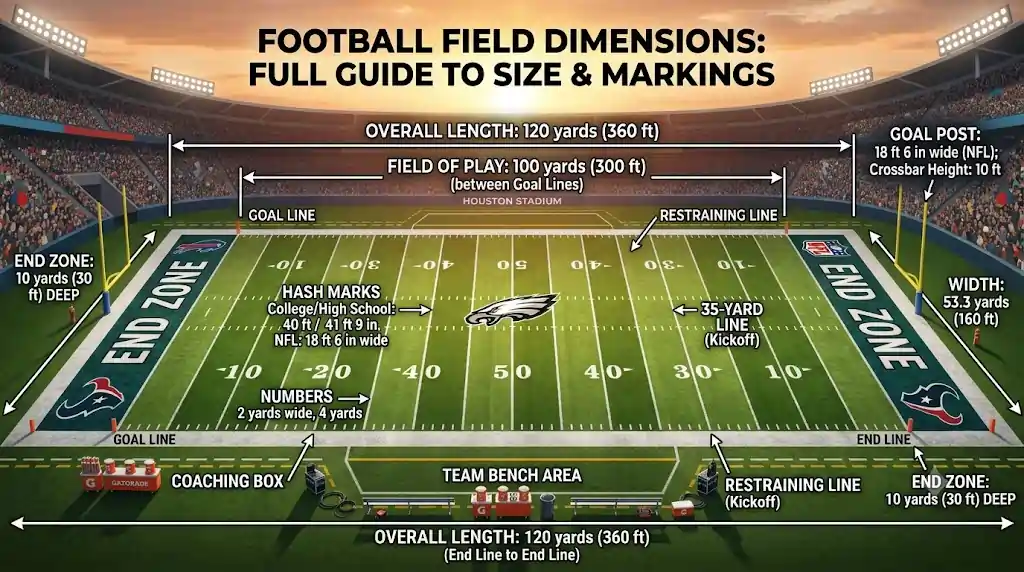
How long is a football field? The standard length for an American football field, from the back of one end zone to the back of the other, is 120 yards. Breaking this down, the actual playing field measures 100 yards long. Each deep scoring area, known as the end zone, adds an extra 10 yards.
If you are measuring for soccer (association football), the length must fall within a range established by the laws of the game. FIFA Law 1 states the touchline must be between 100 yards (90 meters) and 130 yards (120 meters) for international matches. The flexibility allows stadiums to adapt based on available space, but the 100-yard battlefield for American football remains a constant.
Field Width Measured in Feet and Yards
How wide is a football field? The width of an NFL field is 160 feet wide. When you convert that to yards, you get 53.3 yards from sideline to sideline. This width has remained unchanged for decades, creating a tight, violent corridor where 22 players collide on every snap. For high school and college levels, the width stays the same, ensuring consistency as players progress.
If you are looking at soccer, the width is more variable. The optimal width for a FIFA-sanctioned pitch is roughly 75 yards (225 feet), though it can vary between 50 and 100 yards depending on the competition level.
Breaking Down the Playing Field in Acres
A common real estate question is: how many acres is a football field? The math is straightforward. You take the total area (360 feet long by 160 feet wide), which equals 57,600 square feet. Since one acre is 43,560 square feet, a football field covers 1.32 acres.
This does not include the space for stands or the safety border beyond the sidelines. When you factor in the entire stadium footprint and the required clearance, the actual land use usually pushes beyond 1.5 acres. Visualizing this helps you understand why these venues require massive plots of land located on the outskirts of city centers.
American Football Field Markings and Yard Lines
The gridiron name comes from the systematic marking of the field. Every five yards, a solid white line runs from sideline to sideline. These lines are your visual cue for down and distance. Hash marks split the middle of the field; in the NFL, these marks are only 18 feet, 6 inches apart, aligning precisely with the goalposts.
This is far narrower than the college hash marks, which span 40 feet. The placement of the ball dictates the angle of the attack, and the condensed hash marks in professional play force offenses to operate in a much tighter space, significantly increasing the difficulty of sideline passes.
The Dimensions of the End Zone
The end zone isn’t just a flat line; it’s a 10-yard-deep box. That’s 30 feet of territory where the game’s most dramatic moments happen. The exact dimensions of this scoring area are 160 feet wide by 30 feet deep. The boundary is defined by the goal line, which must be crossed for a touchdown.
The pylons placed at the four corners are considered inbounds. If a player dives and touches the pylon while holding the ball, it’s a score. The back line and the sidelines form the hard boundaries, but the airspace above the end zone is infinite; a ball caught legally in the air behind the boundary is a legal catch.
Understanding Soccer Field Size Variations
Unlike the rigid structure of the NFL, a soccer field has leeway. How big is a football field in global football? FIFA provides a minimum and maximum range. The standard for professional 11v11 play sits near 115 yards long by 74 yards wide. Lower-league or youth fields can dip to 100 yards by 50 yards.
This variance means players must adapt their spacing and pressing triggers based on the venue. The “football field background” often discusses the narrow pitches of older English stadiums, which forced a direct style of play because there simply wasn’t space to build slowly from the back.
Metric Conversion: A Football Field in Meters
How many meters is a football field? If you are reading from outside the U.S., the imperial system feels archaic. Let’s simplify the conversion. A 120-yard total field (including end zones) equals 109.7 meters. If you exclude the end zones, the 100-yard playing surface is precisely 91.44 meters.
For international soccer fans, standard pitch lengths hover around 105 meters long by 68 meters wide. This metric conversion is critical for groundskeepers who seed grass using European machinery calibrated in SI units, ensuring the cutting patterns remain straight across the field.
Goal Post Specifications and Placement
The shape of the goal is non-negotiable. In American football, the crossbar is 10 feet high, and the uprights extend 35 feet into the air above it, totaling 45 feet. The width between the two uprights is 18 feet, 6 inches. This matches the NFL hash mark distance, creating a straight vertical target.
In soccer, the goal is an enormous 8 feet high and 8 yards (24 feet) wide. The difference in size explains the scoring frequency. American kickers must thread a needle, while soccer goalkeepers must guard a voluminous cage that forces them to cover approximately 192 square feet of space.
Boundary Lines and Technical Areas
The lines painted on the turf are part of the field. A soccer ball is out of play only when the entirety of the sphere crosses the entirety of the line. The touchlines are the long sides; the goal lines are the short ends.
In American football, the sideline is a dead boundary the instant a player steps on the white paint. The coaches’ box and the team area run parallel to the field, often extending between the 25-yard lines. The rules prevent coaches from wandering past specific zones, turning the chalk on the field into a legal barrier that has cost teams critical penalties during tense moments.
The Impact of Artificial Turf on Exact Measurements
When a natural grass field is replaced by synthetic turf, the measurements must remain identical. You cannot shrink a field just because the carpet rolls are manufactured in standard widths. The permanent markings for American football, soccer, and lacrosse are often stitched in different colors directly into the fibers.
However, some venues use temporary paint for the secondary sport. If a stadium hosts both FIFA games and NFL games, the grounds crew often pulls up the soccer grass sod to reveal the artificial American football field underneath, ensuring the dimensions of both are pristine without messy overlapping lines that confuse players.
High School vs. College vs. Professional Regulations
The progression through the ranks shows subtle differences. How many feet is a football field at the high school level? The total length remains 360 feet (120 yards), and the width stays 160 feet. However, the hash marks are the primary differentiator.
High school uses a massive 53-foot, 4-inch gap between hash marks, spreading the field wide open for offenses. College shrinks it to 40 feet. The NFL’s tight 18-foot, 6-inch gap forces a power run game between the tackles because the short side of the field offers receivers virtually no room to run crisp routes without stepping out of bounds.
Distance Markers and Chain Crew Operations
The classic 10-yard chain remains the ultimate arbiter of possession. Two bright orange sticks connected by a 10-yard chain exactly measure a first down. The chain crew is a civilian team tasked with a mathematically precise job. The down box marks the line of scrimmage, while the chain stays on the sideline. If a measurement is needed, the chain is stretched on the field.
Modern technology like Hawk-Eye is supplementing this, but the physical chain brings a dramatic tension to the game—a visual, definitive clash of inches that determines if a football field length drive ends in glory or failure.
Bonus: Official Measurements Data Table
Below are the strict standards you can reference.
| Feature | American Football (NFL/NCAA) | Soccer (FIFA Standard) |
| Total Length | 120 yd (360 ft) / 109.7 m | 115 yd (345 ft) / 105 m |
| Playing Field Length | 100 yd (300 ft) / 91.4 m | 110 yd (330 ft) / 100 m |
| Total Width | 53.3 yd (160 ft) / 48.8 m | 74 yd (222 ft) / 68 m |
| End Zone / Goal Area | 10 yd (30 ft) Deep | 6 yd (18 ft) Deep |
| Total Area | 1.32 Acres | 1.76 Acres |
| Goal Dimensions | 18.5 ft Wide x 10 ft High | 24 ft Wide x 8 ft High |
Frequently Asked Questions
How many yards is a football field without the end zones?
The playing field is exactly 100 yards long from goal line to goal line. The end zones are not part of the live playing surface; they serve as the scoring boundary. When an announcer says “a 90-yard drive,” they mean the offense moved the ball almost the entire length of the main field. This distinction is crucial for tracking offensive statistics.
How many feet is a football field in total length?
A full American football field measures 360 feet. That represents the 120-yard total package, including both end zones. If you are just measuring the 100-yard battle zone between the goal lines, it’s 300 feet. Visualizing 360 feet is easy; it’s longer than a standard city block, which usually runs about 264 feet.
How many acres is a football field including the sidelines?
The standard internal boundary is 1.32 acres. When you include the mandatory safety runoff areas, benches, and camera zones, the total footprint often reaches 2 acres. Stadium planners must account for this extra space to keep players from crashing into walls. Modern venues push the seats closer, but the physical clearance must remain safe and unobstructed.
Why is a football field called a gridiron?
The term comes from the early pattern of lines that run every five yards. These parallel lines made the surface look exactly like a cooking gridiron, a metal grate used to grill food over an open flame. The name stuck even after the rules evolved. It perfectly describes the cage-like, structured nature of the playing area that confines the chaotic action.
Are all college football field dimensions the same as the NFL?
The outer boundaries are identical, but the hash marks differ. College hash marks sit 40 feet apart, which is much wider than the 18.5-foot gap in the NFL. This drastically changes the geometry of the game. A wide hash mark gives the college offense a huge split field advantage, making it harder for defenses to disguise coverage pre-snap.
How wide is a soccer field compared to an American football field?
A FIFA regulation pitch is significantly wider. It runs 75 yards across, whereas an NFL field is only 53.3 yards wide. That extra 21.7 yards of width changes the physical demands drastically. Soccer players run an average of 7 miles per game largely because of this extra space, while football players explode in short, intense bursts of about 1.25 miles per game.
Conclusion
The space between the lines dictates how the game breathes. You now know the football field is a precise 1.32-acre stage where the narrow 53.3-yard width forces brutal physicality. When you watch the next game, notice how the position of the ball on the hash marks changes the entire offensive strategy. If this deep dive helped you, share it with a coach or a fan who still quotes the wrong numbers. Drop a comment below on which measurement surprised you the most—the acres or the narrow goal posts.