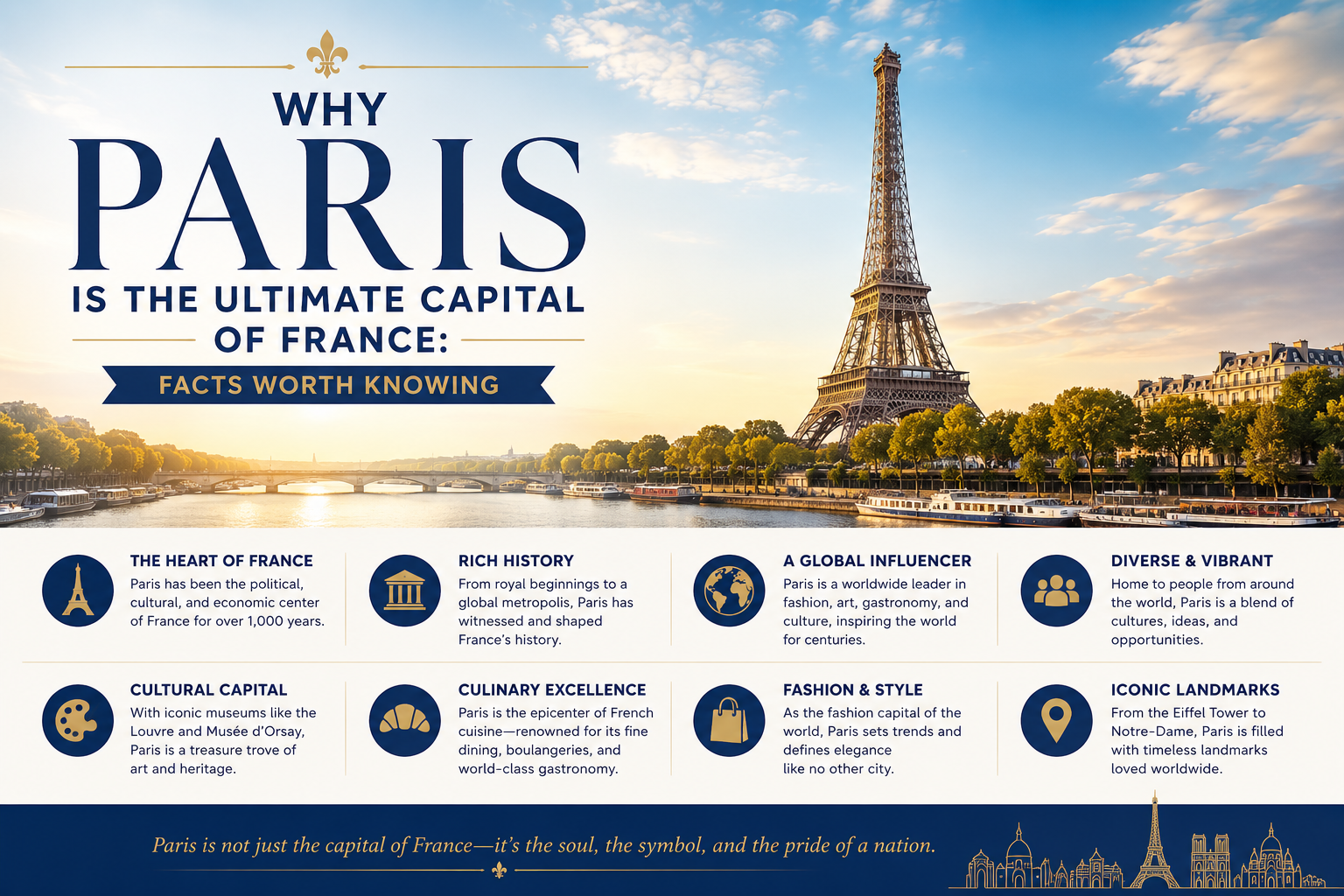
Why Paris is the Ultimate Capital of France: Facts Worth Knowing
How Paris Rose to Power
Paris didn’t become Capital of France overnight. Its rise began with its exceptional location. The Seine River made the city easy to defend and ideal for trade, drawing the attention of rulers as far back as the early Middle Ages. Clovis, the first King of the Franks, recognized its strategic value, and later monarchs like Philip II further cemented the city’s importance.
By the 10th century, Paris had become the undisputed seat of royal power — a status it has held, with rare exceptions, ever since.
Geography: A City Shaped by Its River
Paris covers roughly 105 square kilometers within the Île-de-France region. The Seine River cuts through the heart of the city, naturally dividing it into two distinct halves — the Left Bank (Rive Gauche) and the Right Bank (Rive Droite).
Each arrondissement has its own personality. Montmartre offers bohemian charm and sweeping views. The Marais blends medieval architecture with modern galleries. This patchwork of neighborhoods is part of what makes the city so endlessly fascinating to explore.
The Seat of French Government
As the nation’s capital, Paris is home to the institutions that run the country. The Palais Bourbon houses the National Assembly, where legislation is debated and passed. The Élysée Palace serves as the official residence of the French President. France’s highest courts also operate within the city, making Paris the undisputed center of national authority.
Landmarks Worth Knowing About
No article about Paris would be complete without a nod to its iconic sites:
- The Eiffel Tower — Completed in 1889 as a temporary exhibition structure, it became one of the most recognized symbols on earth.
- The Louvre Museum — The world’s largest art museum, housing over 35,000 works including the Mona Lisa.
- Notre-Dame Cathedral — A Gothic masterpiece dating back to the 12th century, currently being carefully restored after the 2019 fire.
These aren’t just tourist attractions. They represent centuries of artistic ambition and cultural identity.
The Seine: More Than Just Scenery
The Seine is woven into the daily life of Paris. Historically a trade route, today it serves as a backdrop for evening strolls, river cruises, and some of the city’s most beloved views. UNESCO recognized its cultural significance by designating the riverbanks a World Heritage Site — a distinction that reflects just how deeply history is embedded in the city’s landscape.
Paris as an Economic Powerhouse
Paris generates a significant share of France’s total GDP. The city is a global leader in finance, luxury goods, technology, and fashion. Major corporations like L’Oréal and LVMH (parent company of Louis Vuitton) are headquartered here. Meanwhile, tourism brings in millions of visitors annually, fueling restaurants, hotels, and small businesses across the city.
In short, Paris doesn’t just govern France — it largely drives it economically.
Culture, Art, and Everyday Life
The city helped shape Impressionism, Modernism, and the French New Wave in cinema. Today, that creative energy lives on in its hundreds of galleries, independent theaters, open-air markets, and world-class restaurants.
Fashion weeks draw designers from every continent. Michelin-starred chefs compete alongside neighborhood bistros. There’s a reason people say Paris is a feeling as much as a place.
Getting Around the City
Paris has one of the most efficient public transport systems in Europe. The Métro network covers virtually every corner of the city with over 300 stations. High-speed TGV trains connect Paris to Brussels, London, and other European cities in just a few hours. Charles de Gaulle Airport, located northeast of the city center, handles tens of millions of international passengers each year.
A Few Surprising Facts
- Paris earned the nickname “The City of Lights” partly because it was among the first European cities to introduce widespread gas street lighting in the 19th century.
- Despite its size and busy traffic, the city reportedly has just one stop sign within its official boundaries.
- The greater Paris metropolitan area is home to over 12 million people, making it one of the largest urban areas in Europe.
Paris at a Glance
| Feature | Detail |
|---|---|
| Official Name | Paris |
| Country | France |
| Region | Île-de-France |
| City Population | Over 2.1 million |
| Metro Population | Over 12 million |
| Major River | Seine |
| Famous Landmark | Eiffel Tower |
| Presidential Residence | Élysée Palace |
Frequently Asked Questions
Was Paris always France’s capital?
Mostly yes, but not without interruption. During World War II, the Vichy government temporarily relocated to the city of Vichy after Germany occupied Paris. Outside of such extraordinary circumstances, Paris has been the country’s capital for over a thousand years.
How old is Paris?
Celtic tribes known as the Parisii settled on an island in the Seine — today called the Île de la Cité — around the 3rd century BC. Roman conquest followed, and the settlement gradually grew into one of Europe’s most important cities.
Is Paris the largest city in France?
Yes. By both population and economic output, Paris dominates the French urban landscape. No other French city comes close in terms of size, influence, or international profile.
Final Thoughts
Paris is far more than an answer to a geography question. It’s a city that has shaped art, politics, language, and culture on a global scale — and continues to do so today. Whether you’re planning a visit, studying European history, or simply satisfying your curiosity, understanding Paris means understanding a great deal about the modern world.