Stromboli vs Calzone: What’s the Real Difference?
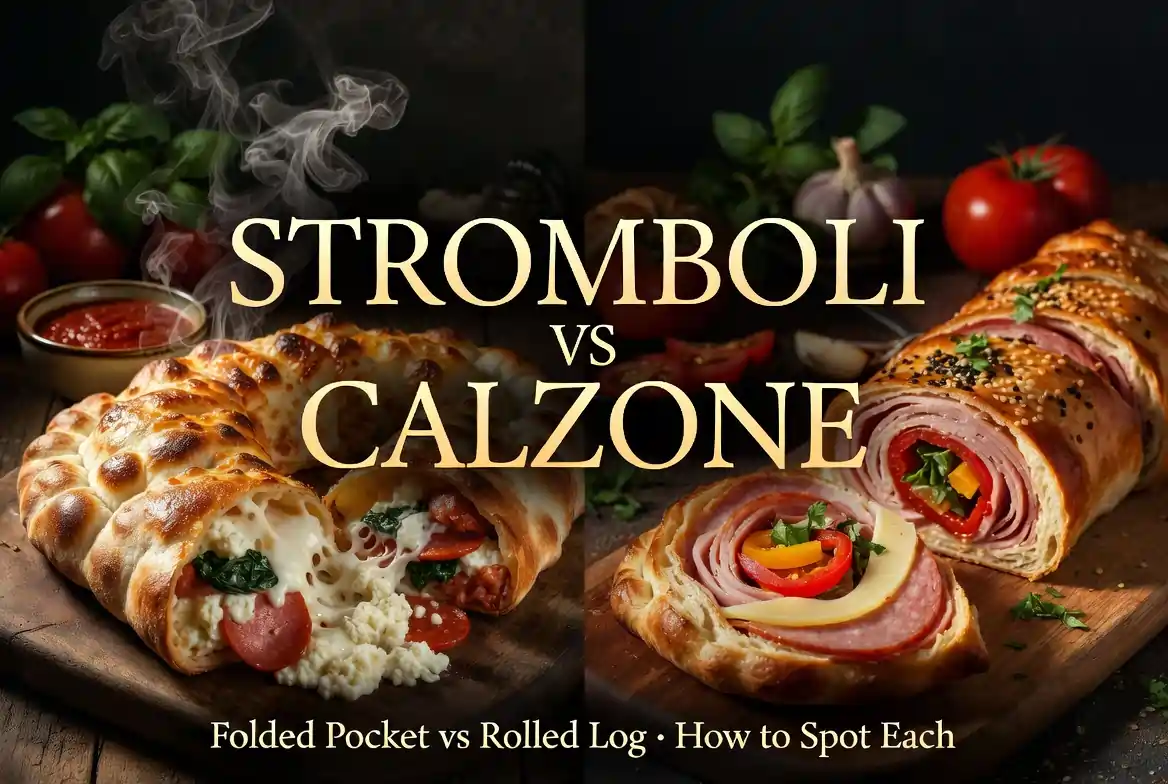
You’re standing at the counter of a buzzing Italian deli, the air thick with the scent of warm yeast and bubbling mozzarella. The server slides two golden-brown beauties onto the counter. One is a perfect crescent, its edges pinched tight, dusted with flour. The other is a glistening, sesame-flecked log, slashed across the top to reveal a hypnotic spiral of meat and cheese. They both look like heaven. But which one is which?
Let’s settle the stromboli vs calzone debate once and for all. While both are essentially pizza dough hugging a soul-warming combination of cheese and meat, they are not the same thing. One is a half-moon pocket born on the streets of Naples. The other was created in a Philadelphia suburb and is an Italian-American rolling log. By the time you finish this guide, you’ll not only spot the difference on sight, but you’ll know exactly what to ask for to sound like a seasoned pro.
Key Takeaways
- The Shape is the Clue: A calzone is a half-moon-shaped, folded pizza pocket sealed with ricotta and mozzarella. A stromboli is a rolled, log-shaped bread filled with meats and cheeses (no ricotta tradition) and sliced into pinwheels.
- Origin Stories Differ: Calzones originated in Naples as a portable, no-plate-required pizza. Stromboli is an Italian-American invention from the 1950s, named after a movie or a volcanic island.
- The Visual Check: Calzones are folded and crimped like a savory turnover. Strombolis are rolled up like a savory jelly roll, often with sauce on the side or baked inside but not layered in ricotta.
- Sauce Placement: Marinara is traditionally served on the side for dipping with a calzone. With stromboli, it’s either baked inside a thin layer or served alongside.
What Is a Calzone?
A calzone is a classic Italian oven-baked folded pizza that forms a half-moon pocket. It’s made by taking a circle of classic pizza dough, piling fillings onto one half, and folding the other half over to create a sealed, crescent-shaped package. The edge is crimped or rolled shut to prevent leakage, and the top is often brushed with olive oil before baking to achieve a crisp, blistered crust.
The soul of a traditional calzone is dairy. Unlike a standard pizza, a calzone almost always relies on a creamy base of whole-milk ricotta and shredded mozzarella. From there, it might include salami, ham, or vegetables, but the ricotta acts as the anchor, binding everything into a rich, spoonable filling once it hits the heat of the oven. Calzones are designed as a complete meal for one, a portable “walk-away pizza” that Neapolitans have enjoyed for centuries. They are eaten whole or cut in half, but never sliced into spirals, and a small bowl of chilled marinara on the side is non-negotiable for dipping.
What Is a Stromboli?
Stromboli is an Italian-American creation of pizza dough rolled around layers of mozzarella, Italian deli meats, and sometimes vegetables, then baked into a golden cylinder and sliced into spiral pinwheels. Unlike the calzone’s gentle fold, a stromboli starts with a rectangular sheet of dough that gets a tidy stack of ingredients laid edge to edge. It’s then rolled up tightly, seam-side down, like a savory jelly roll.
The flavor profile here leans heavily on the deli counter: think wafer-thin capicola, spicy soppressata, pepperoni, and provolone. Cheese is usually always a nice stretch of low-moisture provolone or mozzarella.Ricotta is notably absent from the traditional ingredient list. Stromboli is an American innovation, born in the Philadelphia area in the 1950s, likely named after the movie Stromboli starring Ingrid Bergman or the volcanic island off the coast of Sicily. It’s a shareable, crowd-pleasing log that gets sliced crosswise to reveal a striking spiral, perfect for game days, appetizers, or a messy, magnificent sandwich-like meal.
Stromboli vs Calzone: 7 Key Differences at a Glance
This table is your cheat sheet. If you’re staring down a menu, this is the difference between stromboli and calzone reduced to a single, scannable frame.
| Feature | Calzone | Stromboli |
| Origin | Naples, Italy (18th century) | Philadelphia, USA (1950s) |
| Shape | Half-moon, folded and crimped | Cylindrical log, rolled like a jelly roll |
| Dough | Classic pizza dough | Pizza dough or sometimes Italian bread dough |
| Traditional Fillings | Ricotta, mozzarella, salami, ham, vegetables | Mozzarella, Italian deli meats, no ricotta |
| Sauce | Served on the side for dipping | Sometimes baked inside, or served on side |
| Cheese Emphasis | Ricotta is a defining ingredient | Melted mozzarella/provolone dominates |
| Slicing & Serving | Eaten whole or halved, not sliced | Sliced crosswise into spiral rounds |
Shape and Construction: The most immediate giveaway is the silhouette. A calzone mimics a giant turnover or empanada, its fullness contained by a braided or crimped edge. A stromboli looks like an elongated loaf of bread, smooth on top with diagonal steam vents slashed into the crust.
The Ricotta Factor: This is the hill that Italian food purists will die on. A calzone without ricotta is, arguably, just a poorly folded pizza pocket. True stromboli relies on solid slices or shreds of cheese that melt into distinct layers, not a creamy base. This textural difference is why a calzone filling is spoonable and a stromboli filling holds its spiral shape when sliced.
The Sauce Strategy: While creative chefs break these rules daily, the traditional calzone treats marinara like a condiment—a fresh, cool contrast to the hot, rich pocket. Stromboli often takes a more integrated approach, with a thin schmear of tomato sauce being part of the interior construction, though it’s equally common to see it served dry with sauce on the side.
Origins and History: Naples vs Philadelphia
The calzone’s birth certificate was written in Italian. In 18th-century Naples, street food had to be practical. Sitting down at a table with a plate of slippery, molten pizza was a luxury of time. The calzone was the ingenious solution: a “trouser leg” (the literal translation of calzone) of dough that bundled up the same toppings into a self-contained, handheld meal. You could eat it standing up, walking, or leaning against a wall, no fork required.
The stromboli, by contrast, is a pure product of 20th-century American ingenuity. The widely accepted origin story points to Romano’s Italian Restaurant in Essington, Pennsylvania, just outside Philadelphia. In 1950, Nazzareno “Nat” Romano reportedly experimented with rolling pizza dough around a cache of cold cuts and cheese, naming it after the recently released film Stromboli. Others suggest the name came from the volcanic island. Either way, this was an Italian-American dish, designed to satisfy the heartier appetites of the post-war era with layers of deli meat that would never have been found in a Neapolitan forno. One is Old World practicality; the other is New World abundance.
How to Tell Stromboli from Calzone on Sight
Forget the menu description. Use your eyes.
A calzone sits on the plate like a puffed, golden crescent moon. Its most distinctive feature is the sealed, crimped edge—think of a baked apple turnover, but filled with molten cheese. The surface is often smooth, maybe pierced with a single steam hole, and dusted with flour or cornmeal. Cut into it, and you’ll find a cavernous, creamy interior where ricotta has fused with other cheeses into a unified, almost sauce-like filling.
A stromboli is an architectural log. The seam is hidden on the bottom, and the top is distinguished by several deliberate slashes that expose the spiraled layers beneath. The crust is often glossed with an egg wash, garlic butter, and a shower of sesame seeds or Parmesan. Its cross-section is its signature: a clean, colorful pinwheel of meat, cheese, and optional vegetables. This visual contrast—a monochromatic creamy pocket versus a defined, multi-colored spiral—is the fail-safe way to tell them apart.
Fillings and Flavor Profiles
When you bite into a calzone, you experience richness first. The whole-milk ricotta creates a luscious, mild, and slightly grainy texture that coats the palate, punctuated by salty bursts of ham or salami. Vegetables like spinach or mushroom become embedded in the cheese matrix, creating a unified, almost casserole-like bite. The flavor is comforting, creamy, and rarely spicy. It’s a meal for a knife and fork, a dish that demands you slow down.
Biting into a stromboli is a more structured, layered experience. Because the cheese (usually mozzarella or provolone) and meats are stacked in sheets, they remain distinct. You get a sequential hit of peppery capicola, a ribbon of molten cheese, a tangy note of sauce, and the chewy pull of the crust. The flavor is bolder, sharper, and meatier. It’s a high-contrast eating experience, often designed to be eaten out of hand, slice by spiral slice, making it a more casual, shareable affair.
How to Eat and Order Like a Pro
Menus, especially in pizza shops with no Old World pedigree, often blur these lines. You might see a “stromboli” that’s simply a folded calzone or a “calzone” that arrives suspiciously like a loaf. Knowledge is your ordering power.
If you want a creamy, self-contained pocket of ricotta and cheese that requires a fork and a side of marinara, order the calzone. If you’re picturing a meaty, savory roll that can be sliced into shareable pinwheels and eaten with your hands, you want a stromboli.
When in doubt, use this simple script at the counter: “Is your stromboli rolled and sliced, or folded like a calzone?” A server who knows the answer will respect the question immediately. If they look confused, just ask: “Does it have ricotta inside?” A “yes” almost always means you’re getting a calzone, regardless of what it’s called on the chalkboard.
Can You Make Stromboli and Calzone at Home?
Both are shockingly easy to make with a good batch of pizza dough. The technique, not the ingredients, is the differentiator.
For a calzone, roll your dough into a 10-inch circle. Pile your ricotta blend, mozzarella, and fillings onto one half, leaving a 1-inch border. Fold the empty half over, pinch and roll the edges to create a tight seal, cut a few steam vents, and bake at 450°F until deeply golden.
For a stromboli, roll the dough into a rectangle. Layer your meats and cheeses across the surface, leaving a border. Starting from a long edge, roll it up like a cinnamon roll, tucking in the sides as you go. Place it seam-side down, slash the top several times with a sharp knife to prevent it from bursting, and bake at 400–425°F. Let it rest before slicing, or you’ll lose your cheese lava flow to the cutting board.
Nutritional Comparison: Which Is Healthier?
Neither of these golden-brown parcels will be mistaken for health food, but their structural differences create different nutritional profiles. A typical restaurant calzone, hefty with full-fat ricotta, whole-milk mozzarella, and an egg binder, can easily soar past 1,200 calories. The saturated fat content is significant, though it’s also packed with protein and calcium.
A stromboli, while often similarly calorically dense, derives much of its energy from processed deli meats. This means it can be substantially higher in sodium—often exceeding half a day’s recommended value in a single serving. The absence of ricotta might save you a few grams of fat, but the trade-off is a longer ingredient label. If you’re looking for a lighter option, a veggie-packed calzone made with part-skim ricotta is your best bet. For both, portion control is the real answer: enjoy half and save the rest.
Conclusion
The stromboli vs calzone debate ultimately comes down to three things: shape, ricotta, and origin. A calzone is a folded Italian crescent bound by creamy ricotta. A stromboli is a rolled, Italian-American log swirling with deli meats and mozzarella. Now that you can spot a crimped edge from a spiral slice, you’re ready to order with confidence—or roll up your sleeves and make both. For a homemade dough that works beautifully with either style, check out our guide to perfect pizza dough and bring a taste of Naples and Philly to your own oven.
Frequently Asked Questions
Is stromboli just a rolled calzone?
No. While both use pizza dough, a calzone is folded into a half-moon and traditionally contains ricotta. A stromboli is rolled into a log, slices into spirals, and relies on mozzarella or provolone without ricotta.
Does calzone always have ricotta cheese?
In a traditional Neapolitan calzone, yes, ricotta is a defining ingredient that creates its creamy texture. However, modern variations sometimes omit it, blurring the lines, but a true calzone uses ricotta as a base.
Can you put sauce inside a calzone?
Traditionalists generally avoid putting sauce inside, as it can make the dough soggy and interfere with the ricotta’s texture. It’s almost always served on the side for dipping, keeping the crust crisp.
What is the difference between a stromboli and a panzerotti?
A panzerotti is a smaller, deep-fried turnover that resembles a miniature calzone with a very similar ricotta-and-mozzarella filling. Stromboli is baked, rolled into a log, and made with deli meats without ricotta.
How do you keep a stromboli from unrolling?
Start with a cold, slightly sticky dough and roll it very tightly, sealing the seam with a bit of water or egg wash. Placing it seam-side down on the pan is the most critical step to prevent unrolling during baking.
Which is more popular: stromboli or calzone?
Popularity is regional. Calzones are more widespread globally due to their deep Italian roots. Stromboli dominates in the northeastern United States, particularly around Philadelphia, where it’s a standard pizzeria and game-day staple.