What is the Demographic Transition Model? (Stages & Simple Guide)
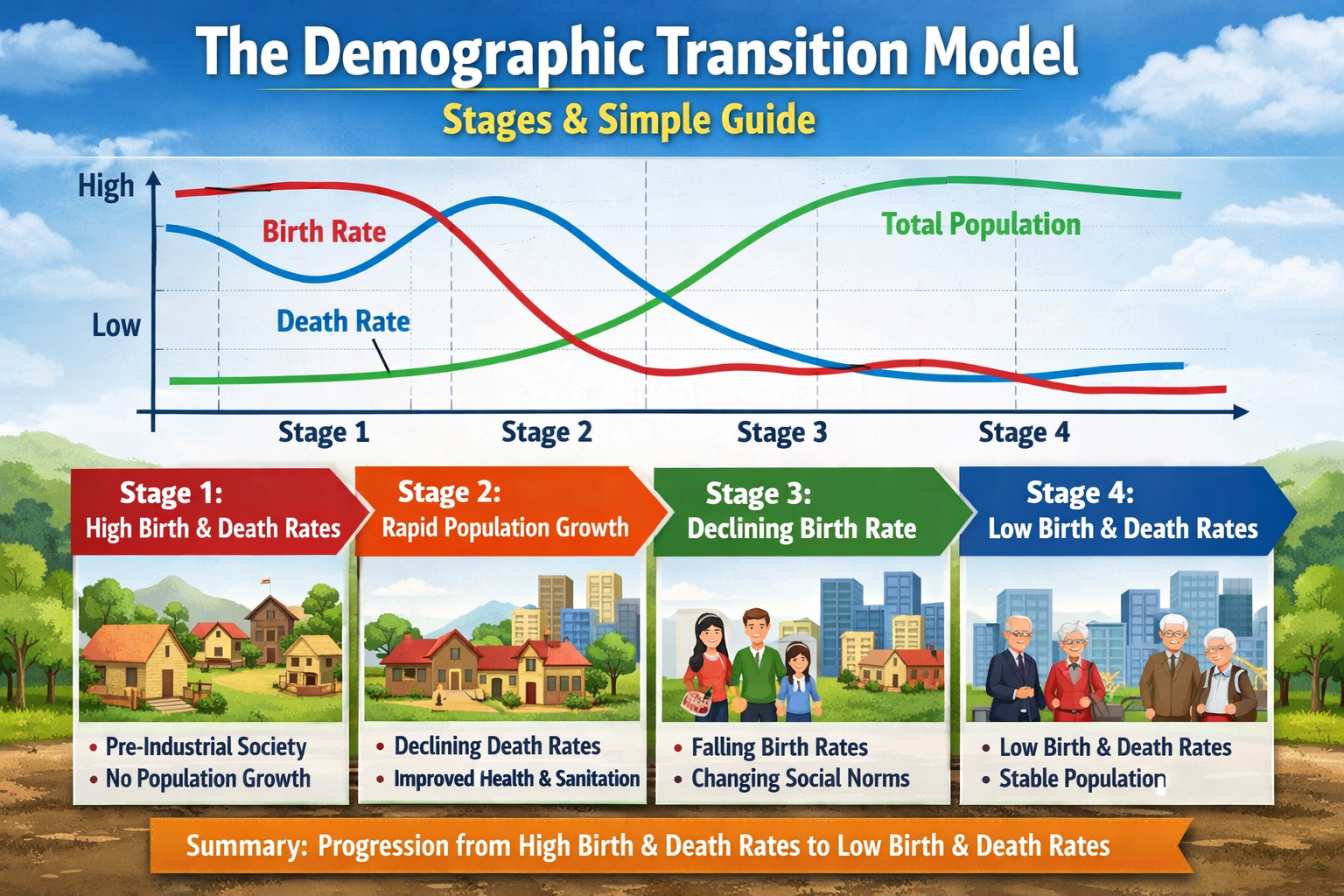
Understanding the Heart of Population Change
Have you ever stopped to think about why some countries grow so fast while others seem to stay the same size? This is a huge puzzle that scientists and geographers love to solve. To help them, they use a special tool called the demographic transition model. This model is like a historical roadmap. It shows how a country’s population shifts as it moves from a simple farming life to a high-tech modern society. It is the best way to see the big picture of human growth.
The demographic transition model focuses on two very basic things: how many people are born and how many people die. When you look at these two numbers over a long time, a clear pattern starts to emerge. Most nations follow the same path as they get better at medicine, farming, and education. This guide will help you understand every part of that path in a way that is fun and very easy to follow. Let’s start this exciting journey through human history together!
What is the Demographic Transition Model?
If you need a clear demographic transition model definition, think of it as a story of progress. In the beginning, life was hard and dangerous, so people had many children. As things like clean water and doctors became common, fewer people died. This change created a massive boom in the number of people on Earth. The model tracks this shift through five distinct chapters, or stages. Each stage represents a different level of wealth and health for a country and its citizens.
Asking “what is the demographic transition model” is the first step to becoming a geography expert. It is a way to measure how a society is doing. It isn’t just about cold numbers on a paper. It is about how families live, how many years grandma survives, and how many kids go to school. This model helps us predict what will happen next. It allows governments to plan for more houses, better hospitals, and more jobs for the future generations that are coming soon.
Demographic Transition Model Definition AP Human Geography
For students, the demographic transition model ap human geography version is a core part of the syllabus. In this class, you learn that population change is tied to a country’s development. Experts use terms like “Crude Birth Rate” and “Crude Death Rate” to map out the stages. The model teaches us that as a nation earns more money, its birth rates naturally go down. This happens because people start to value education and careers more than having very large families for farm work.
Learning the demographic transition model ap human geography curriculum helps you understand the world today. It explains why a country like Niger has a very different population shape than a country like Italy. Students learn to read population pyramids, which are visual graphs of the model. These graphs show the age and gender of a population at a glance. By mastering this, you can look at any country and tell exactly how healthy and wealthy its people are without even visiting them!
Detailed Breakdown of the 5 Stages
To really master this topic, we need to look at each of the demographic transition model stages individually. Each stage has its own unique personality and set of challenges. Below is a list of what happens in each part of the human journey:
- Stage 1: The Pre-Industrial Age
- Birth rates are extremely high because there is no birth control.
- Death rates are also very high due to disease and poor food.
- The total population stays very low and stable.
- Families need many children to help with manual farming work.
- There is almost no modern medicine or clean water systems.
- Stage 2: The Boom Begins
- Death rates fall very quickly because of better food and medicine.
- Birth rates stay high because traditions take time to change.
- The population grows at a very fast, explosive rate.
- This is often called the “Industrial Revolution” stage.
- More children survive into adulthood than ever before in history.
- Stage 3: The Slow Down
- Birth rates finally start to fall as people move to cities.
- Death rates continue to drop but at a much slower pace.
- The population is still growing but not as fast as in Stage 2.
- Women get more education and start working outside the home.
- Having a huge family becomes too expensive in an urban setting.
- Stage 4: The Stable Modern Life
- Birth and death rates are both very low and almost equal.
- The total population becomes stable and stops growing quickly.
- This is the “Post-Industrial” stage seen in the USA and UK.
- People live very long lives thanks to advanced medical technology.
- Most families choose to have only one or two children.
- Stage 5: The Shrinking Phase
- The birth rate falls even lower than the death rate.
- The total population actually starts to get smaller every year.
- There are more elderly people than there are young children.
- This is a new stage seen in countries like Japan and Germany.
- Governments may struggle to find enough workers for their factories.
The Big Comparison: Key Factors in the Model
Understanding the demographic transition model stages is easier when you compare them side-by-side. The following table highlights the major differences that help geographers rank a country.
| Stage | Birth Rate Level | Death Rate Level | Population Growth | Major Cause of Change |
| Stage 1 | Very High | Very High | Very Low | Lack of medicine and food |
| Stage 2 | High | Falling Fast | Very High | Better hygiene and farming |
| Stage 3 | Falling | Falling | Slowing Down | Education and city living |
| Stage 4 | Low | Low | Stable | Advanced health and wealth |
| Stage 5 | Very Low | Low | Shrinking | Personal choice and agin |
Deep Dive into Stage 1: The Struggle for Survival
Long ago, every single human on Earth lived in Stage 1 of the demographic transition model. This was a time before paved roads, electricity, or even basic soaps. People lived in small groups and worked very hard every day just to find enough to eat. Because there were no vaccines, many people died from simple infections. This kept the population from growing. Even though many babies were born, many passed away before they could grow up. It was a cycle of high births and high deaths.
In this stage, the demographic transition model definition shows us a “High Stationary” population. There were no real cities yet, and most people were farmers or hunters. Parents had as many children as possible so that someone would be around to care for them when they got old. Since there were no pension plans or social security, children were a family’s only insurance policy. While it sounds very difficult to us today, this stage lasted for thousands of years before the first big changes began to happen.
Exploring Stage 2: Why the Population Explodes
Stage 2 is when the world really starts to change. This part of the demographic transition model is sparked by the Industrial Revolution. Farmers started using machines to grow more food, so people didn’t go hungry as often. Scientists also discovered that germs cause disease, which led to cleaner water and better trash pickup. Suddenly, the death rate dropped like a rock! People were living longer, and babies were staying healthy. This created a massive gap between the number of people being born and the number dying.
When you look at the demographic transition model ap human geography notes, Stage 2 is called “Early Expanding.” This is because the population is expanding at its fastest rate. Many countries in Africa and South Asia are in this stage right now. They have millions of young people, which is great for the future but hard for schools and hospitals to handle. It is a time of incredible energy and growth. It marks the moment a country truly begins its journey toward becoming a modern, developed nation.
Stage 3: The Move to the City
As countries move into Stage 3 of the demographic transition model stages, life becomes more about the city than the farm. This is a very important shift in human behavior. On a farm, children are extra workers who help for free. But in a city apartment, children become “expensive” because they need clothes, school supplies, and food that the family can’t grow themselves. Because of this, parents naturally start to have fewer kids. They choose to focus their money and time on just two or three children instead of ten.
Education is the biggest driver of change in Stage 3. As more girls go to school and university, they get jobs and start families later in life. This causes the birth rate to fall significantly. At the same time, medicine continues to improve, so the death rate stays low. The population is still growing, but the “explosion” from Stage 2 is over. The country is now “Late Expanding.” Nations like Brazil, Mexico, and India are great examples of societies currently navigating through this transition stage.
Stage 4: Achieving a Modern Balance
Stage 4 is where most developed nations like the United States, Canada, and Australia are today. In this part of the demographic transition model, the birth rate and the death rate finally meet again at a very low level. This is called “Low Stationary.” The population is no longer growing rapidly. Instead, it is very stable. Most people live in comfortable homes, have access to high-speed internet, and can see a doctor whenever they feel sick. Life is much more predictable than it was in the earlier stages.
In Stage 4, the focus of society shifts to services and technology. People work in offices or on computers rather than in fields or factories. Because people live so long, the biggest challenge in this stage is taking care of the elderly. Since there aren’t millions of new babies being born, there are fewer young people to work and pay taxes. However, Stage 4 is generally considered a time of great peace and prosperity for most citizens. It is the goal that many developing countries are working hard to reach.
Understanding the New Stage 5
Some geographers have added a new chapter to the demographic transition model called Stage 5. This happens when the birth rate becomes even lower than the death rate. This isn’t because people are dying more, but because so few babies are being born. In countries like Japan, many young people choose to focus on their careers or travel instead of starting a family. This means the total number of people in the country starts to drop every single year. It is a very strange and new situation for humans.
Stage 5 presents a brand-new set of problems. If there are no new workers, who will run the trains or build the houses? Countries in this stage often try to encourage people from other nations to move there to help keep the economy going. It shows that the demographic transition model is always evolving. We are constantly learning new things about how humans live and grow together. Whether Stage 5 is a good or bad thing is still being debated by experts all around the world today.
Comparison: Developing vs. Developed Nations
To understand the demographic transition model definition in action, it helps to compare two different types of countries. This table shows how Stage 2 and Stage 4 nations look very different in their daily lives.
| Feature | Stage 2 (Developing) | Stage 4 (Developed) |
| Typical Country | Niger or Afghanistan | USA or United Kingdom |
| Main Job Type | Farming and Labor | Services and Technology |
| Family Size | 5 to 7 children | 1 to 2 children |
| Life Expectancy | Around 50-60 years | Around 80+ years |
| Major Goal | Survival and Growth | Quality of Life and Stability |
Why Is the DTM Important for the Future?
You might wonder why we spend so much time studying the demographic transition model stages. The reason is simple: it helps us save lives and plan a better world. If we know a country is in Stage 2, we can send more vaccines and help build more schools. If we know a country is in Stage 4, we can focus on retirement plans and elderly healthcare. It is a tool for empathy and understanding. It shows that no country is “better” than another; they are all just at different points on the same human timeline.
Furthermore, the demographic transition model ap human geography teaches us about the environment. More people in Stage 2 means we need more food and land. Fewer people in Stage 5 might mean nature has a chance to recover. By watching these population trends, we can figure out how to live on Earth without using up all its resources. It is the ultimate guide to the past, present, and future of our global family. Everyone should know these basics to understand the news and the world around them.
Frequently Asked Questions (FAQs)
1. What is the demographic transition model in easy words?
It is a simple graph that shows how countries move from having many births and deaths to having very few births and deaths as they get richer.
2. Which stage of the demographic transition model is the most dangerous?
Stage 1 is the most dangerous because death rates are very high and medicine is not available. However, Stage 2 can be stressful because the population grows too fast for the food supply.
3. Why is the demographic transition model ap human geography so popular?
It is popular because it explains almost everything about why countries are different. It helps students understand economics, health, and history all in one simple chart.
4. Can a country skip a stage?
Usually, no. Countries must go through the stages in order. However, some countries move through them very quickly because of modern technology and global help.
5. What is the demographic transition model definition of a “stable” population?
A stable population happens in Stage 1 and Stage 4. It means the number of people being born is roughly the same as the number of people dying, so the total count stays the same.
6. Does every country want to reach Stage 4?
Most countries aim for Stage 4 because it means their people are healthy, educated, and living long lives. It is often seen as the peak of modern development.
Conclusion: A World in Transition
In conclusion, the demographic transition model is the most powerful tool we have to understand our growing world. It tells a story of how humans have used science, education, and hard work to overcome disease and hunger. From the ancient struggles of Stage 1 to the modern stability of Stage 4, we have come a very long way. By studying the demographic transition model definition and its stages, you are learning about the very heartbeat of humanity. It is a journey we are all taking together as one global family.
Whether you are a student or just a curious reader, understanding these patterns helps you see the world more clearly. You can now look at a country and understand its challenges and its successes. The demographic transition model stages remind us that progress is possible for everyone. As we continue to share knowledge and medicine, more nations will find the balance and health they deserve. Thank you for exploring this fascinating topic with us today!